
Undrained Shear Strength Correlations
Undrained shear strength Su may be correlated with several parameters, including the following:
Standard Penetration Test:
Su = 6N (Eq. 1)
where N is the SPT-N60 number
| SPT ‘N’ blows per 300 mm* | Shear strength (kPa) | Term | Abbreviation | Field guide |
|---|---|---|---|---|
| 0–2 | <12 | Very soft | VS | A finger can be pushed well into the soil with little effort |
| 2–4 | 12–25 | Soft | S | A finger can be pushed into the soil to about 25 mm depth |
| 4–8 | 25–50 | Firm | F | The soil can be penetrated about 5 mm with the thumb |
| 8–15 | 50–100 | Stiff | St | The surface of the soil can be indented with the thumb, but not penetrated |
| 15–30 | 100–200 | Very stiff | VSt | The surface of the soil can be marked by the fingers, but not indented with thumb pressure |
| >30 | >200 | Hard | H | The surface of the soil can be marked only with the thumb nail |
Dynamic Cone Penetrometer:
DCP results can be used to estimate the consistency of subgrade soils.
| Consistency | Blows/100 mm |
|---|---|
| Very soft to Soft | <1 |
| Firm | 1–2 |
| Stiff | 3–4 |
| Very stiff | 5–10 |
| Hard | >10 |
Atterberg Limits:
In normally consolidated clays, the undrained shear strength su to effective overburden pressure p′o ratio can be determined as:
1. Bjerrum and Simons (1960) provided Eq. (2) as a best fit to their work:
su/p′o = 0.45(IP)1/2, IP > 0.5 (Eq. 2)
Using the liquidity index IL, they derived an approximation of
su/p′o = 0.18(IL)1/2, IL > 0.5 (Eq. 3)
In both of these equations, use the plasticity index IP and liquidity index IL as decimal entries.
2. A linear equation for the su/p′o ratio for nc clays was presented earlier in curve form by Skempton and Henkel (1953) which can be approximated from the plots as:
su/p′o = 0.11 + 0.37IP (Eq. 4)
In this equation use IP in decimal.
3. Karlsson and Viberg (1967) suggest
su/p′o = 0.5wL, wL > 0.20 (Eq. 5)
where the liquid limit wL is a decimal value.
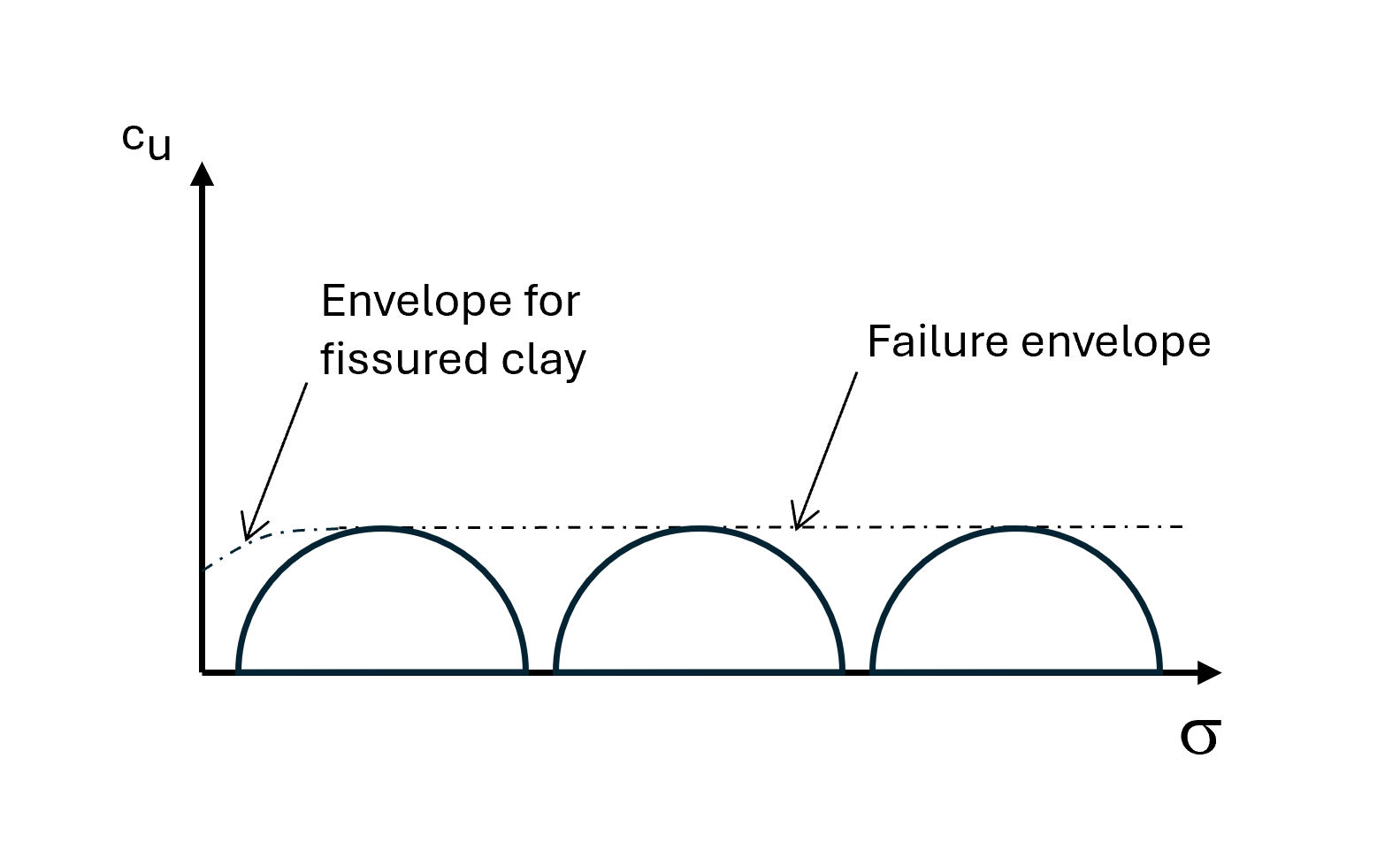
Figure - Unconsolidated-undrained triaxial test results for saturated clay